.jpg)
Israel Growth Forum
2025 Annual report & Q1 2026
As we look back on 2025 and the first quarter of 2026, we do so at a time when Operation “Shaagat HaAri” is once again bringing renewed geopolitical uncertainty. While these developments form the current backdrop, the past year was shaped by a broader set of challenges for Israel’s growth ecosystem, including economic pressure, rapid technological change, a highly selective investment climate and the appreciation of the NIS against the USD, creating headwinds for companies with dollar-denominated revenues.
Despite this environment, forum members completed one IPO and two significant M&A transactions, clear indicators of resilience and continued global demand for Israeli innovation.
Throughout the year, we worked closely with policymakers and stakeholders to help ensure that Israel’s policy framework remains supportive of innovation and long-term competitiveness. This newsletter highlights the Forum’s key engagements over the past year and sets out our priorities for the year ahead.
We would like to thank our advisors for their guidance and continued support: Orna Levy and Hani Nahhas from EY, Prof. Shachar Hadar from Meitar, and Prof. Assaf Hamdani from Tel Aviv University, who has been advising the forum on tax legislation and corporate governance. We also thank the IGF’s General Counsels, CFOs, Tax Directors, HR Directors, CISOs, and Product Managers for their active participation, practical insights, and willingness to share experience, which have supported our ongoing work.
Promoting Policy
We play a crucial role in bridging the gap between the government and the tech industry, giving large tech companies a voice around the decision-making table. Through active engagement with policymakers, we advocate for policies that create a favorable environment for tech companies to thrive.
Proposed changes to the Israeli Companies Registry
Recent legislative proposals suggest updates to the Israeli Companies Registry, with potential implications for corporate reporting and compliance. We submitted an official response and are in ongoing dialogue with government stakeholders, including participation in a roundtable discussion with the Companies Registrar and other relevant representatives. Throughout this process, we have stressed the need to avoid additional bureaucratic burdens on companies and to rely on existing enforcement mechanisms before tightening reporting requirements.
Desired outcome: Avoidance of additional reporting burdens on companies.
Corporate Governance
Aligning Israeli Rules with Global Markets
Following the approval of recent amendments to the Israeli Companies Law, the Knesset’s Constitution, Law, and Justice Committee approved updated regulations easing certain corporate governance requirements for companies whose shares are traded outside Israel. We participated in the parliamentary discussions to help ensure the regulations reflect the needs of Israeli growth companies listed abroad. The changes align Israeli rules with common international practices, extend relief to the board’s nominations committee, and allow venture capital funds to hold up to 35% of a company’s shares in the years following an IPO without being presumed to control the company, while maintaining a balanced approach to corporate governance.
Achieved outcome: Approval of updated regulations by the Knesset Committee aligning Israeli corporate governance requirements with common international practice and providing meaningful relief for Israeli companies listed abroad.
AI Policy
The AI Policy Council
We took the stage at a national conference on AI policy in Israel, positioning the industry’s perspective at the center of the discussion. This engagement formed part of our ongoing relationship with the newly established AI body at the Prime Minister’s Office (PMO) and reflected our active contribution to shaping Israel’s emerging AI policy framework.
Achieved outcome: Successfully placed on the public agenda the principle that AI policy in Israel must be developed in close partnership with industry, rather than formulated by the government alone.
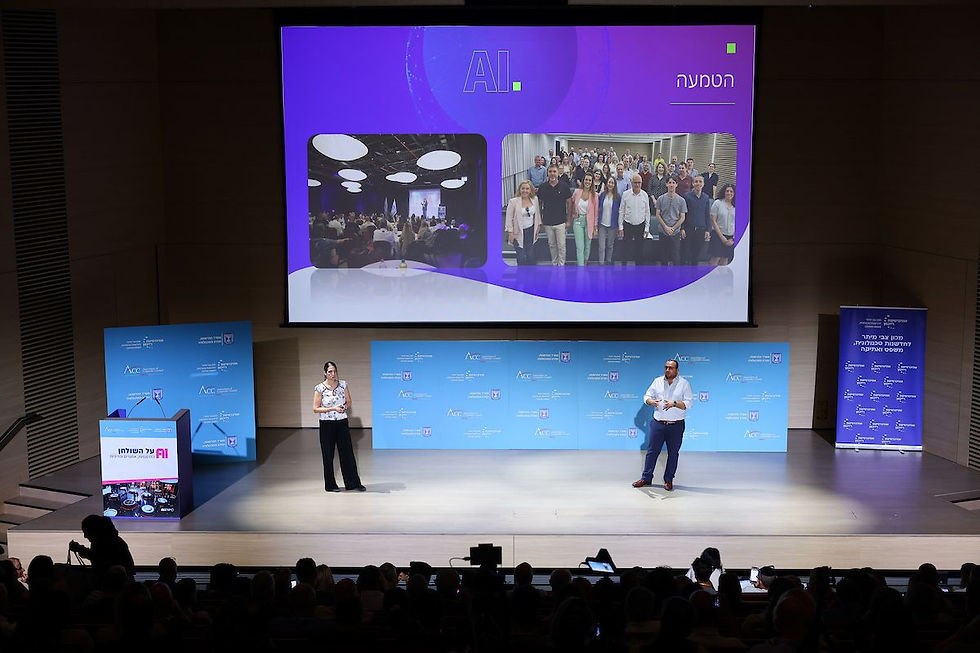
AI on the Table: Roundtables on AI in Key Sectors In partnership with the Israel AI Regulation and Policy Center
AI Stack RFI: Joint AmCham Response
In response to the U.S. Department of Commerce RFI on promoting the export of the American AI technology stack, we partnered with AmCham Israel to form a focused alliance, enabling an effective, high-quality, and coordinated submission. The paper highlights Israel’s unique strengths—top-tier talent, rapid innovation, and deep integration with U.S. tech leaders—and advocates for a flexible, best-in-breed AI stack that incorporates trusted foreign components, including Israeli technologies. It also supports industry-led consortia and streamlined export mechanisms to enhance global competitiveness. The desired outcome is to ensure that Israel remains an integral partner in the U.S.-led AI ecosystem—fully included in the benefits and incentives of the stack framework, not left outside it.
Desired outcome: Israel remains an integral part of the U.S.-led AI stack ecosystem, fully included in its incentives and benefits, rather than being excluded from its opportunities.
Talent
Shaping the future of tech talent in the age of AI
We continue to play an active role in the National Committee for Expanding Human Capital in the Tech Sector, chaired by Dadi Perlmutter. As the Committee prepares its annual progress report, we are focusing on how government policy must adapt to shifts in the tech workforce driven by the AI revolution, with particular attention to the evolving role of junior talent in Israel’s tech ecosystem.
.jpg)
Desired outcome: Academia–industry action plan for junior talent development.
Recent legislative proposals under Israel’s 2026 Economic Plan would expand National Insurance reporting through Form 100 to include employee occupation and primary work location, enabling the transfer of this data to the Central Bureau of Statistics (CBS) to generate more accurate workforce data and better inform employment policy. While supporting this objective, we emphasized the need to avoid additional administrative burdens.
Workforce classification: proposed changes
Desired outcome: Adaptation of the new reporting framework to the operational needs of industry, while maintaining efficiency and minimizing compliance burdens.
Cloud Software Transactions
Following recent clarification of the tax treatment of cloud software in the United States, we are engaging with the Israel Tax Authority on this issue, and developing a policy position to support a modern, market-aligned classification framework. The focus of this work is the tax characterization of software transactions in a market where software is no longer distributed through physical media or device-based installations, and where existing frameworks require updating to reflect current practice.
Desired outcome: Issuance of a directive by the Israel Tax Authority recognizing cloud software transactions as services for Israeli tax purposes.
Tax Incentives (QRTC)
The legislation establishing the Qualified Refundable Tax Credit (QRTC) regime has been approved by the Knesset Finance Committee as part of the Economic Arrangements Law and is expected to be approved by the Knesset in final readings. The framework introduces a tax credit mechanism for eligible R&D expenses, aimed at strengthening Israel’s competitiveness in attracting and retaining technology activity, particularly in light of the global minimum tax environment. We were actively involved in shaping the law, working closely with policymakers to ensure it is aligned with the realities of growth companies and relevant for those expected to benefit from it in the coming years. Among the key provisions, eligible tax credits may convert into a cash grant after four years, enabling meaningful benefits also for companies that are not yet profitable.
Achieved outcome: Approval of a competitive, growth-oriented QRTC framework that incentivizes R&D investment and is accessible to both profitable and non-profitable companies.
Pillar 2: “Top up” Tax
Israel has taken a significant step in implementing the OECD’s Pillar Two framework, approving a new minimum tax regime for multinational groups with revenues exceeding €750 million. While not immediately applicable to all forum companies, the changes are highly relevant for growth companies expected to reach this threshold in the coming years, and for Israel’s broader competitiveness as a scaling destination. Throughout the legislative process, we worked closely with the Ministry of Finance, the Israel Tax Authority, and the Israel Innovation Authority, with active involvement from our Tax Directors and advisors at EY, to help shape a balanced outcome.
Achieved outcome: The bill was approved before the end of 2025 with major changes we highlighted as essential to the industry.
Tax policy
Marketing Asset
After more than a year of discussions on this issue, we have received a draft directive from the Israel Tax Authority and submitted our professional comments, with the aim of ensuring that the final guidance provides the clarity and certainty required by our companies. We continue to engage closely with senior officials at the Israel Tax Authority and the Ministry of Finance to support a well-aligned and practical outcome
Desired outcome: Issuance of a clear and comprehensive directive by the Israel Tax Authority that provides regulatory certainty and aligns with industry needs.
Michal Sarig Kaduri, IGF CEO : Opening Remarks at the Knesset Finance Committee on the QRTC Law | Feb 10, 2026
Cyber legislation
Shaping the Permanent Cyber Law Framework
The National Cyber Directorate recently published for public comment a draft permanent Cyber Law, intended to replace the temporary framework of recent years. Following consultations with CISOs and legal experts from the forum, we submitted a consolidated industry position highlighting structural concerns in the draft — including an overly broad scope, far-reaching supervisory powers, expansive and immediate reporting obligations, disproportionate sanctions, and regulatory mechanisms that may create ongoing uncertainty and misalignment with accepted market standards. We continue engaging with the authorities to help shape a balanced, proportionate, and internationally aligned final framework.
Desired outcome: A permanent Cyber Law that is risk-based and proportionate, aligned with global regulatory standards, and provides legal certainty while avoiding unnecessary compliance burdens on growth and technology companies.

Developing the Ecosystem
Similar to any ecosystem, the resilience and effectiveness of Israel's tech environment hinge upon its networks. In collaboration with strategic partners, we facilitate opportunities for growth companies to get together, share knowledge, provide mutual support and collaborate around shared interests and values.
CEO/COO Dinner
In September, a group of CEOs and senior executives from the Forum came together for our annual executive dinner. This year, we were honored to host a special guest, Daniel Hagari, for an in-depth conversation on leadership in challenging times. The evening provided a valuable opportunity to reconnect in person and hear firsthand about what’s happening across your companies. Thank you to everyone who joined us!
Professional Communities
We continue to strengthen the professional communities within the Forum, driven by bottom-up demand from our peer network. The People Analytics group has already met several times, and toward the end of January we hosted a meetup for data and analytics professionals from Forum companies. If you’re interested in initiating a focused professional discussion group with other member companies, we’d be glad to hear from you. We share many common challenges, and there is always value in learning from one another.

IGF Data and analytics professionals meetup
Leading Change
Mahatma Gandhi's mantra, "Be the change you seek," resonates deeply with us. The forum serves as a change agent, spearheading projects and initiatives aimed at addressing the challenges and opportunities that confront the our Tech industry.
Israeli Growth Case Studies in the Making
Over the past few months, we’ve been working on two case studies focused on forum companies, intended for publication through Harvard Business Publishing and developed in collaboration with Reichman University. These are the first two cases in a six-case series that will form a dedicated module on Israeli growth companies, highlighting diverse stories and growth strategies. The goal is to enable this case library to be used as a teaching module at leading academic institutions in Israel and around the world.

Bar-Ilan Product Management Cluster – Ongoing Impact
The third cohort of the Bar-Ilan Product Management Cluster has officially launched. As part of the program, several Forum companies have already hosted students for an immersive learning day focused on the role of the Product Manager. Many thanks to the product leaders and product managers at Bringg, CyberArk and AppsFlyer for opening their doors, hosting the students, and sharing hands-on insights into the Product Manager role.



Arava – Emergency Innovation & Northern Recovery
As part of the Arava North platform’s ongoing work, we are currently developing two new initiatives to support resilience and recovery in the North. The first is the WellTech North Fair, designed to connect resilience and mental-health service providers with technology companies offering solutions in these fields, and encourage the adoption of impactful tech tools. In parallel, we are building a system to support individuals and families considering relocation to the North, providing a comprehensive, one-stop solution for their transition. We are also continuing our work in support of small businesses in northern Israel, providing a digital platform that centralizes essential data, information, and access to relevant grants.
2026 Roadmap
Area
Activity
Q1
Q2
Q3
Q4
Policy
QRTC (working with the Ministry of Finance, ITA, Israel Innovation Authority and the Knesset)
Policy
Working with the Ministry of Finance and the ITA: marketing asset
Policy
Green track for M&A’s
Policy
New residency reform
Policy
Cloud software transactions
Policy
Extension and update of the temporary provision under the Law for the Encouragement of Knowledge-Intensive Industry
Policy
Defining the IGF work plan for the incoming government (elections preparation)
Policy
Cyber Legislation – Minimizing Unnecessary Burden
Ecosystem
Shaping the Future of Tech Talent through the National Committee
Ecosystem
Communities: Data analytics meetup
Ecosystem
The 8th Israel Growth Summit
Ecosystem
Communities: PA strategy and learning network
Ecosystem
CEO/COO Dinner
Leading Change
Finalizing the 2nd Israeli growth case study (growth case study library)
Leading Change
Working on the 3rd Israeli growth case study
Leading Change
Working on the 4th Israeli growth case study
Leading Change
Arava North
Infrastructure
Launching the new IGF website
Infrastructure
IGF Fee Collection
Cyber Legislation - Minimizing Unnecessary Burden
Q1
Q2
Q3
Q4
Defining the IGF work plan for the incoming government (elections preperations)
Q1
Q2
Q3
Q4
Extension and update of the temporary provision under the Law for the Encouragement of Knowledge-Intensive Industry
Q1
Q2
Q3
Q4
Cloud software transactions
Q1
Q2
Q3
Q4
New residency reform
Q1
Q2
Q3
Q4
Green track for M&A'S
Q1
Q2
Q3
Q4
Q3
QRTC (working with the Ministry of Finance, ITA, Israel Innovation Authority and the Knesset)
Q1
Q2
Q4
Q1
Q2
Q3
Q4
Working with the Ministry of Finance and the ITA: marketing asset
Policy
CEO/COO Dinner
Q1
Q2
Q3
Q4
Communities: PA strategy and learning network
Q1
Q2
Q3
Q4
The 8th Israel Growth Summit
Q1
Q2
Q3
Q4
Q3
Shaping the Future of Tech Talent through the National Committee
Q1
Q2
Q4
Q1
Q2
Q3
Q4
Communities: Data analytics meetup
Ecosystem
Arava North
Q1
Q2
Q3
Q4
Working on the 4th Israeli growth case study
Q1
Q2
Q3
Q4
Q3
Finalizing the 2nd Israeli growth case study (growth case study library)
Q1
Q2
Q4
Q1
Q2
Q3
Q4
Working on the 3rd Israeli growth case study
Leading change
Q3
Launching the new IGF website
Q1
Q2
Q4
Q1
Q2
Q3
Q4
IGF Fee Collection
Infrastracture
Thank you for reading. We look forward to staying in touch
Michal Sarig Kaduri
Hila Lipschiz